
Hair Transplant Results: Hairline Design in Hair Transplant
The hairline is the signature of the surgery. It is where identity meets surgical judgement. In evaluating hair transplant results, the first question is simple: does the hairline look like it belongs to the patient?
A well-designed hairline is irregular, asymmetrical in micro-detail, and age-appropriate in macro-position. It respects temporal recessions and avoids the temptation of a straight, artificially dense border. Poorly planned hairlines often seen in suboptimal hair transplant results in India tend to be too low, too straight, and too dense, creating an unnatural frame that ages poorly. The irony is that what appears impressive in the first year often becomes conspicuous by the third.
The principle is restraint. A hairline must anticipate future hair loss, not just correct present deficiency. Otherwise, one ends up, quite literally, building a façade without a foundation.
Best Hair Transplant Results: Graft Distribution and Density Planning
Density is an illusion, not an absolute. The human eye perceives fullness based on contrast, shadow, and framing factors that can be manipulated through intelligent graft placement.
In achieving best hair transplant results, priority must be given to the frontal forelock. This region acts as the visual anchor. When adequately dense, it creates the perception of overall fullness, even if the mid-scalp and crown are less populated. Conversely, distributing grafts uniformly across a large bald area leads to mediocrity everywhere.
Many disappointing hair transplant before and after transformations stem from this very mistake an attempt to “cover everything” rather than “define something.” In surgical planning, one must choose emphasis over equality. The canvas is finite; the paint, limited.
Hair Transplant in India: Donor Area Management and Long-Term Planning
The donor area is the unsung hero and often the silent victim of hair transplantation. It is finite, genetically stable, and unforgiving of excess.
In the context of hair transplant in India, where large sessions are frequently marketed, there is a tendency to overharvest in pursuit of dramatic immediate results. This is, in my opinion, a short-sighted approach. The donor is not merely a source; it is a reserve that must last a lifetime.
Signs of poor donor management include patchiness, visible thinning, and an over-reliance on beard or body hair in early procedures. A well-managed donor, on the other hand, appears untouched uniform, dense, and natural.
Hair loss is progressive. A patient who is Norwood III today may become Norwood V tomorrow. If the donor has been exhausted in the first sitting, future correction becomes not just difficult, but sometimes impossible. As the idiom goes, one must keep some powder dry.
Hair Transplant Results in India: Direction and Angulation of Grafts
Hair does not grow randomly; it follows a pattern a choreography dictated by nature. Replicating this pattern is one of the most technically demanding aspects of the procedure.
In analysing hair transplant results in India, one must look beyond density and examine behaviour. Does the hair fall naturally? Does it align with adjacent strands? Can it be combed effortlessly?
Incorrect angulation leads to hair that stands upright, grows against the natural direction, or resists styling. This is particularly evident in the crown, where the whorl pattern requires precise replication. A technically sound transplant is not just about placing grafts—it is about placing them correctly in three-dimensional space.
When direction is right, the result is invisible. When it is wrong, no amount of density can conceal it.
Best Hair Transplant in India: Surgeon Involvement and Surgical Ethics
In the current landscape, where hair transplantation has become increasingly commoditised, surgeon involvement has emerged as a critical differentiator.
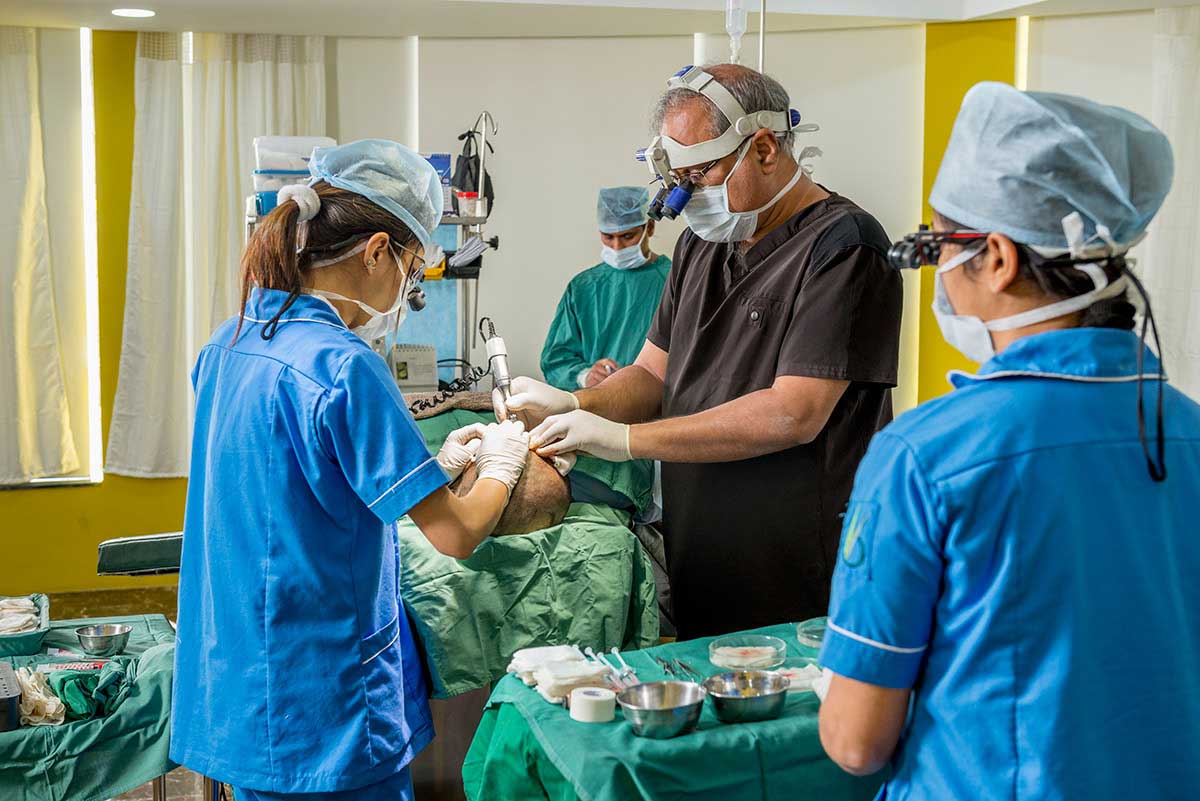
Many clinics operate on high-volume models, where the surgeon performs the initial consultation and design, while technicians execute the majority of the procedure. While delegation is inevitable to some extent, the key aesthetic steps recipient site creation, angulation, and density planning must remain under the surgeon’s direct control.
The difference between a craftsman and a production line is subtle initially, but profound over time. The best hair transplant results in India are invariably those where the surgeon remains intimately involved throughout the procedure.