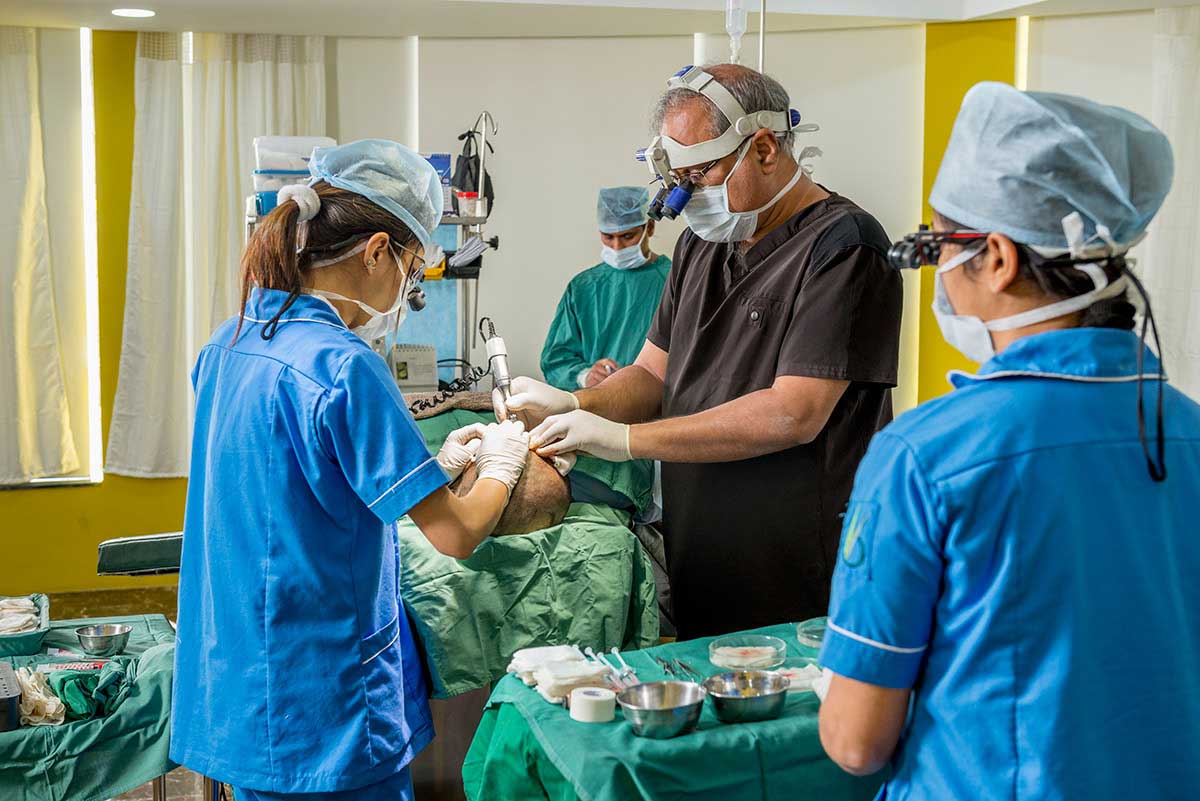

One of the greatest revolutions in modern FUE hair transplant surgery was not merely the elimination of the long linear scar associated with traditional FUT. It was the realization that the scalp was no longer the only donor source available to the surgeon.
For patients with Grade 6 or Grade 7 baldness, this changed everything.
When the scalp donor supply becomes limited, the surgeon must think beyond the scalp. Among all available body donor sources, beard grafts have consistently proven to be the most valuable supplementary donor. Their calibre, robustness, high survival rate and excellent cosmetic contribution make them indispensable in carefully selected patients undergoing hair transplant in India and around the world.
However, beard grafts should never be viewed simply as “extra grafts.” They represent a finite and precious donor resource that demands meticulous planning and even greater respect than the scalp donor itself.
Why Beard Hair?
The average patient with advanced androgenetic alopecia simply does not possess enough scalp follicles to recreate the density of youth across an extensive bald scalp.
Nature imposes limits.
The surgeon must work within them.
Beard hair provides an elegant solution because it differs from most other body hair. It is thicker, stronger and often grows for a longer duration than chest, arm or leg hair. Once strategically blended with scalp follicles, particularly in the mid-scalp and crown, beard grafts can dramatically improve visual density while preserving precious scalp reserves.
For this reason, beard hair has become the preferred secondary donor source in modern body hair transplant surgery.
Is FUE Really Scarless?
Patients often hear the phrase “scarless hair transplant.”
Technically, that is incorrect.
Every punch used during Follicular Unit Extraction (FUE) creates a microscopic scar.
The objective is not to eliminate scarring.
The objective is to make those scars clinically invisible.
When beard harvesting is performed correctly, the natural beard shadow conceals these tiny extraction sites so effectively that even after complete healing, they are extremely difficult to identify.
This distinction is important because ethical patient counselling begins with scientific accuracy rather than marketing terminology.
Not Every Part of the Beard Behaves the Same
One of the common misconceptions is that the entire beard can be harvested in exactly the same manner.
It cannot.
Different regions of the beard possess different anatomical characteristics, hair angles and cosmetic significance.
For practical surgical planning, I divide the beard into five harvesting zones.
Zone 1 Along the Mandibular Border
This region provides excellent-quality grafts with robust calibre.
However, it also demands restraint.
As long as harvesting remains within the natural beard shadow, extraction sites usually heal beautifully. The lateral borders, however, deserve particular caution. Extending beyond the natural beard outline may leave tiny hypopigmented dots that become visible when the patient shaves closely.
A successful surgeon knows not only where to harvest but also where to stop.

Zones 2 and 3 The Ideal Harvest
The submandibular and upper neck regions often provide the safest and most rewarding donor supply.
These areas usually possess excellent follicular density while remaining naturally concealed beneath the beard shadow.
For many patients requiring beard graft hair transplant, these zones contribute the majority of harvested follicles.
Why the Lower Neck is Different
The lower neck presents an entirely different anatomical challenge.
Throughout most of the beard, hair exits the skin at approximately forty-five degrees.
In the lower neck, however, the follicles emerge almost flush with the skin surface.
The exit angle may be less than fifteen degrees.
Although this difference appears minor, it dramatically changes the geometry of extraction.
Imagine pushing a drinking straw vertically into soft soil.
The opening remains perfectly circular.
Now insert the same straw almost parallel to the surface.
Instead of a circle, the opening immediately becomes longer and more oval.
Exactly the same principle applies to beard follicles.
Because the follicle travels a much longer distance within the skin before emerging, the extraction wound also becomes elongated.
Occasionally, after complete healing, this may appear as a faint, elongated mark resembling the delicate trail of a shooting star rather than a tiny circular dot.
This is often a consequence of anatomy rather than surgical error.
Understanding these subtle anatomical differences allows surgeons to modify their harvesting strategy and minimize donor visibility.
What Determines an Invisible Beard Donor?
Invisible donor healing is never the result of luck.
It is the cumulative effect of dozens of small surgical decisions.
At Darling Buds Clinic, our philosophy has always been that donor preservation is as important as recipient restoration.
Successful beard harvesting depends upon:
- Remaining strictly within the beard shadow whenever possible.
- Respecting the lateral limits of the mandibular beard.
- Careful patient selection.
- Conservative graft planning.
- Small-diameter precision punches.
- Perfectly concentric, wobble-free punch rotation.
- High-quality sharp punches that minimise tissue trauma.
- Excellent illumination.
- High magnification throughout harvesting.
- Precise alignment with the natural hair exit angle.
- Gentle atraumatic extraction.
- Appropriate spacing between harvested follicles.
- Avoiding repeated attempts on the same follicle.
- Preserving long-term donor density.
- Never sacrificing future options for present gain.
These details may appear small individually.
Collectively, they determine whether the donor remains virtually undetectable years after surgery.
The True Measure of a Beard Hair Transplant
Patients naturally admire the transplanted hair on the scalp.
Surgeons should be equally proud of what cannot be seen.
The finest hair transplant results are not judged solely by a natural hairline or increased density.
They are judged by the integrity of the donor area.
If a patient can shave his beard closely one year after surgery and nobody can identify where hundreds or even thousands of grafts were harvested, then the procedure has respected both science and aesthetics.
That, in my opinion, represents the true elegance of modern FUE hair transplantation.
At Darling Buds Clinic, our philosophy has remained unchanged for over two decades: respect the donor before you restore the recipient. For patients with Norwood Grade 6 baldness, beard grafts can transform the possibilities of hair restoration but only when they are harvested with anatomical precision, surgical restraint and a lifelong commitment to donor preservation.
Video :- https://youtu.be/hM4fuPrjUu0
Video :- https://youtu.be/gArQ3Tiik44