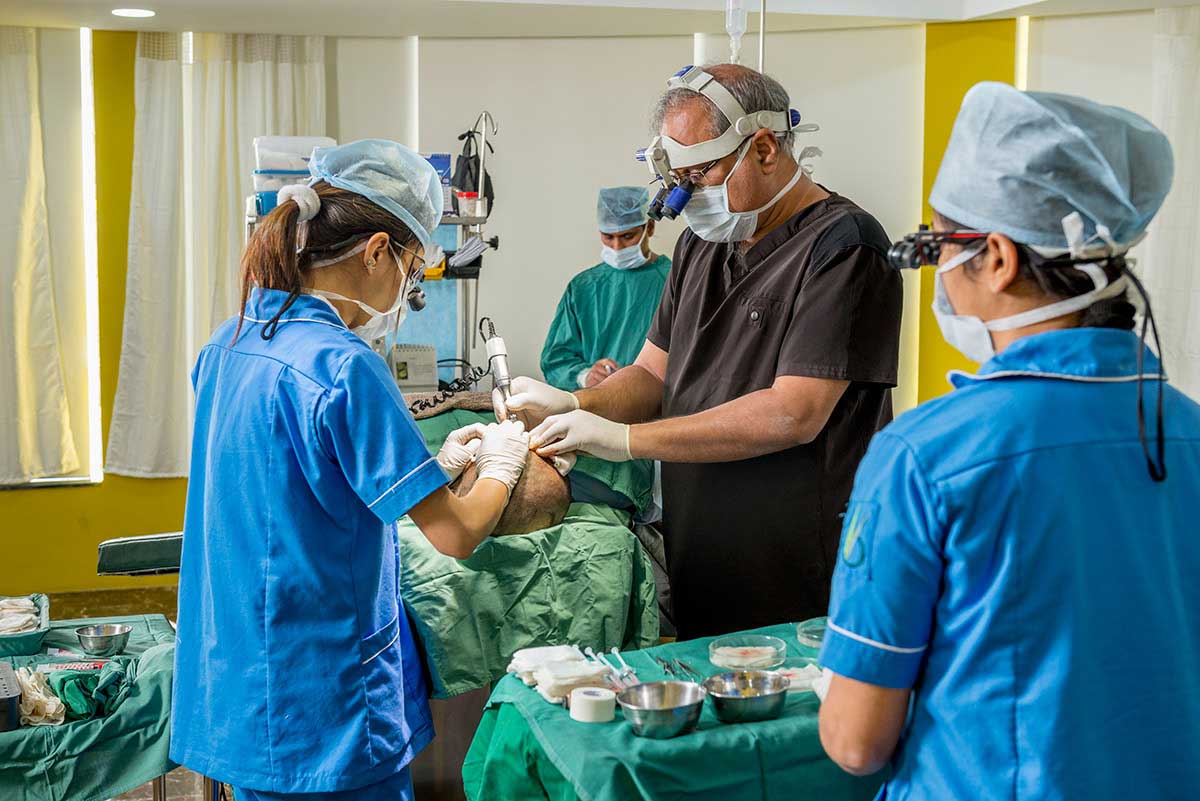

Hair transplantation has advanced considerably over the past two decades. Smaller punches, refined implantation devices, high-magnification surgery and better hairline design have made natural-looking results possible. Yet success depends on something more important than the instruments used: the experience, judgement and direct involvement of the surgeon.
Dr Tejinder Bhatti is a board-certified plastic surgeon who has devoted about 20 years exclusively to surgical hair restoration. Unlike many high-volume practices where the doctor supervises several procedures or delegates major surgical stages, Dr Bhatti personally performs every crucial step. This surgeon-led model is central to the DHX technique developed and practised by him.
What Makes a Surgeon-Led Hair Transplant Different?
A hair transplant is often described as the movement of follicles from the donor area to a bald or thinning area. In reality, it is the permanent redistribution of a limited biological resource.
The donor area contains a finite number of follicles that can be safely removed during a patient’s lifetime. Once a follicular unit is extracted, it cannot be replaced. Poor harvesting may produce visible thinning, patchiness or scarring that is difficult to correct.
For this reason, Dr Bhatti believes donor harvesting should never be treated as a routine technical exercise. Each follicular unit must be assessed according to its position, direction, calibre, surrounding density and long-term value.
During surgery, he personally administers anaesthesia, plans and performs the donor harvest, designs the hairline, creates the recipient sites and oversees graft placement. This continuity allows one surgical plan to be followed from the first incision to the final graft.
The doctor who designs the result should also perform the steps that determine it. Too many cooks can spoil the broth, and in hair transplantation the consequences may be permanent.
What Is the DHX Hair Transplant Technique?
DHX is a doctor-performed approach to follicular unit extraction based on careful donor harvesting, strategic graft selection and precise recipient-site creation.
The technique is not defined merely by a punch, blade or implantation device. Instruments can assist a surgeon, but they cannot replace surgical judgement.
Under the DHX approach, grafts are selected according to the role they will perform. Delicate single-hair grafts are reserved for the leading edge of the hairline, while stronger follicular units are placed behind them to build visual density. Hair calibre, curl, colour contrast and growth direction are considered when planning their distribution.
Recipient sites are created at carefully selected angles and directions to reproduce how natural hair emerges from the scalp. Hairline irregularities, temple-point design and the transition from finer to thicker hairs are planned to avoid the rigid or pluggy appearance seen after poorly executed surgery.
Naturalness does not depend only on how many grafts are transplanted. It depends on where each graft is placed, how it is angled and whether it belongs in that position.
Why Does Plastic-Surgery Training Matter?
Hair transplantation requires more than follicle extraction. It demands an understanding of facial proportions, wound healing, scar behaviour, vascular anatomy, tissue handling and long-term surgical planning.
As a plastic surgeon, Dr Bhatti approaches hair restoration as reconstructive aesthetic surgery rather than as a numerical exercise in graft placement. The aim is not simply to cover bald skin, but to create an age-appropriate frame for the face while preserving the donor area for the future.
This is especially important in younger patients whose hair loss may continue for decades. An aggressively low hairline or excessive use of donor grafts may look impressive initially but become unnatural as baldness progresses.
Medical treatment, family history, expected progression, donor capacity and the possibility of future procedures must therefore be considered before surgery is recommended.
Is Cutting-Edge Technology Enough?
Modern technology has improved hair transplantation. High-magnification optics, refined punches, sapphire blades and controlled implantation systems can improve precision and reduce tissue trauma when used correctly.
However, sophisticated terminology should not be confused with surgical quality. Machines cannot decide whether a patient is suitable for surgery, design an age-appropriate hairline or identify an unsafe donor area.
Technology is most valuable when guided by an experienced surgeon. The sharpest tool in the box is still only as effective as the judgement behind it.
A Practice Built Around One Patient at a Time
Dr Bhatti’s practice is structured around focused surgical involvement rather than high-volume turnover. By limiting the number of procedures and remaining personally involved throughout surgery, he aims to maintain consistency, accountability and advanced surgical precision.
Patients should not ask only which technique or machine a clinic uses. They should ask who will design the hairline, extract the grafts, create the recipient sites and remain personally involved throughout the procedure.
A hair transplant can influence appearance for decades. The most important decision may therefore not be the name of the technique, but the experience and involvement of the surgeon performing it.
Video :- https://youtu.be/8UB-adD8Ipk