
A hair transplant that has been a success shouldn’t look as though it has been a successful hair transplant.
That might seem paradoxical, but it could well be the most important principle in surgical hair restoration, since the best outcome is one in which the person appears younger, better shaped and more confident, yet the observer cannot say precisely what has changed.
The example presented here shows what philosophy entails. Our aim has never been simply to transfer follicles from the back of the scalp to the front; it has instead been to create a hairline that naturally belongs on the face.
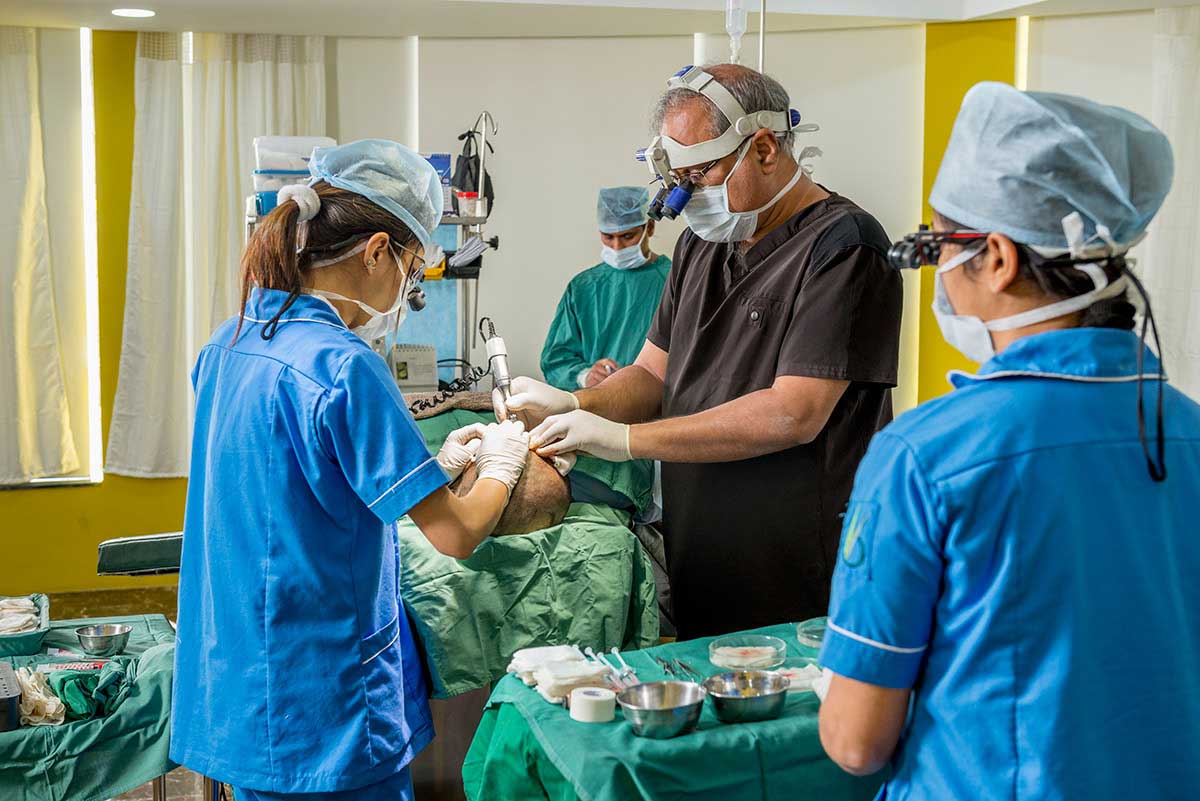
The DHX® method developed by Dr Tejinder Bhatti at Darling Buds Clinics Mumbai & Chandigarh is based on this approach, with direct involvement by the doctor being at the core of the procedure.
Hair transplantation is an aesthetic operation, not a graft-counting exercise
“Maximum density.”
Follicles never exist on their own; instead they have to become part of a three-dimensional aesthetic structure which includes the forehead, the temples, facial proportions, hair direction, calibre and the future progression of baldness.
A graft that survives from a technical point of view but is in the wrong position is still an aesthetic failure.
That is the reason why hairline design cannot be left to a template; the height of the hairline, the extent of temporal recession, the transition zone, the macro-irregularities, the micro-irregularities, the direction of growth and the distribution of the individual hair grafts all have to match the particular face.
The face is then nicely bordered by the hairline.
When they are wrongly placed, even excellent graft survival may produce a result that announces itself from across the room.

What distinguishes DHX®?
DHX® represents Dr Bhatti’s evolution of contemporary FUE hair transplantation around one central principle:
The surgeon has to be responsible for the surgical decisions which determine the final outcome.
The essence of DHX® therefore does not lie in an implanter pen, forceps, sapphire blade or any other individual instrument.
Technology has its place, but the tail should never wag the dog.
The company DHX® makes doctor involvement, not device branding, the focal point of hair transplantation.
Why an implanter pen cannot define a modern hair transplant
Implanter devices have been used in hair transplantation for many years and are still useful when in the right hands. Yet, the practice of describing a hair transplant procedure mainly in terms of the device employed for implantation tends to confuse the instrument with the operation.
Two surgeons can use an identical pen and produce completely different results.
The pen may help place a follicle.
The surgeon decides where that follicle after placement will do best.
Naturalness is created in the first few millimetres.
The frontal transition zone is where natural hair transplantation is often won or lost.
A natural hairline does not begin abruptly as a wall of dense hair. Nature usually creates a softer transition containing finer hairs and subtle irregularity before progressing into greater density behind.
Direction matters as much.
Hair emerging at inappropriate angles can look coarse or artificial, even when density is good. Recipient sites therefore need to reproduce the natural orientation of hair across different regions of the scalp.
The donor area is part of the result.
One of the most neglected aspects of hair transplantation is the donor scalp.
The donor supply is finite.
Once a follicle has been removed, it cannot be harvested again.
This becomes especially important in younger patients because androgenetic alopecia may continue progressing for many years after the first operation.
That is not thoughtful hair restoration.
DHX® therefore incorporates conservative donor planning and selective harvesting into the overall surgical strategy. The goal is not simply to achieve the largest possible procedure today, but to preserve enough biological capital for tomorrow.
The transformation should belong to the patient.
The most satisfying hair transplant results do not create a new identity.
They restore something that appears as though it should always have been there.
This is the difference between simply transplanting hair and performing surgical hair restoration.
At Darling Buds Clinic, DHX® has been developed around this philosophy: meticulous planning, preservation of the donor area, natural hairline construction and—above all—direct involvement of the surgeon in the stages that determine the aesthetic outcome.
Devices will continue to change. New pens, punches and implantation systems will continue to appear.
But surgical judgement cannot be packaged inside an instrument.
And when the result is truly natural, the greatest compliment is often the simplest one: