
This is the story of such a moment.
Mr. Tushar Royden walked into Darling Buds Clinic on the tenth day following his hair transplant procedure in India. He was a well-informed man, articulate, confident, and, like many patients, deeply invested in the promise of restoration. His surgery had been performed meticulously by Dr Bhatti—every graft extracted with precision, every slit created with anatomical respect, every follicular unit placed as though it were a note in a carefully composed symphony.
And yet, as he sat across the consultation desk, there was unease.
“Doctor,” he said, “is this okay?”
The scalp told its own story.
Instead of the expected fine, powdery shedding of crusts, what one saw was a dense, adherent layer—thick, dark, and stubbornly clinging to the transplanted zone. It was not a complication in the dramatic sense. There was no pus, no overt infection, no alarming redness. But to a trained eye, this was not quiet healing. Something was amiss.
Dr. Bhatti paused for a moment, then replied with characteristic clarity.
“Definitely not. You cannot get seeds planted and then abandon the field and expect a rich harvest!”
To understand what had gone wrong, one must first understand what a crust truly is.
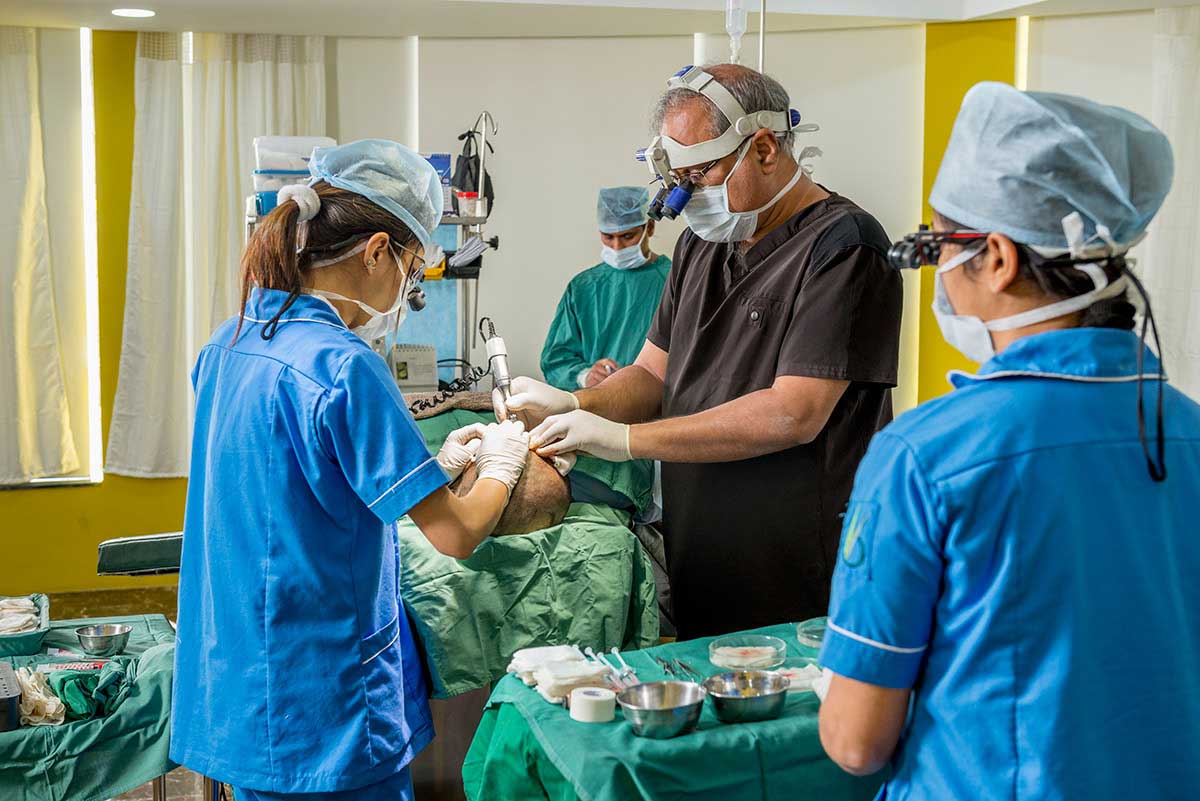
In the theatre, during a hair transplant procedure in India at Darling Buds Clinic, every action is deliberate. Each slit made in the recipient area is not merely a mechanical step—it is a controlled micro-injury. The body, ever vigilant, responds instantly. Capillaries disrupted by the incision release a small amount of blood. Serum seeps out. Platelets aggregate. Fibrin begins to weave its delicate mesh.
This is haemostasis—the body’s first act of defence.
Now, as this mixture of blood and serum reaches the surface, it does not remain fluid indefinitely. Exposure to air leads to desiccation. The fluid dries. It consolidates. And what remains is what we clinically refer to as a “crust.”
But to call it merely dried blood would be an oversimplification.
A crust is a composite structure. It contains serum proteins, fibrin strands, platelets, traces of red blood cells, and fragments of disrupted epidermal tissue. It encases the emerging hair shaft like a temporary sheath. It is, in essence, nature’s biological dressing—an ephemeral shield designed to protect the graft during its most vulnerable phase.
In a well-managed post-operative course, these crusts are almost unremarkable. They are fine, soft, and loosely adherent. They serve their purpose quietly and then retreat. By day seven, they begin to loosen. By day ten to fourteen, they have disappeared, leaving behind a scalp that is calm, clean, and healing in silence.
That is the normal.
But healing has little tolerance for neglect.
When Dr. Bhatti gently parted the hair and examined Mr. Arora’s scalp under magnification, the problem became evident—not in the grafts themselves, but in the environment they had been left in.
“What was your aftercare like in the first 24 hours?” he asked.
There was hesitation.
“I… sprayed saline, but not very frequently. It was too much of routine. I thought it would heal anyway.”
There it was—the quiet deviation that had tipped the balance.
In the immediate hours following a hair transplant, the scalp exists in a state of controlled vulnerability. The epidermal barrier has been breached. Microvascular channels are dilated. An inflammatory cascade has been initiated—not pathological, but purposeful. It is the body preparing the ground for healing.
At this stage, hydration is not a comfort measure. It is a physiological necessity.
Saline spraying, particularly in the first few hours, serves a critical role. It prevents the serum from drying prematurely. It maintains a moist environment, allowing the fibrin matrix to remain pliable rather than rigid. It ensures that the crusts that form are thin and non-adherent.
But when this step is neglected, the sequence alters.
The serum, instead of remaining fluid, dries excessively. It binds more firmly with fibrin and cellular debris. The crusts that form are no longer delicate—they are dense, thick, and tightly adherent. They do not loosen easily. They persist.
And in their persistence lies the problem.
Initially, crusts are protective. They shield the graft from external trauma, reduce exposure, and support early stabilisation. But when they overstay their welcome, they transform from guardians to obstacles.
Thick crusts act as reservoirs. They can trap bacteria—not necessarily leading to overt infection, but creating a microenvironment where low-grade inflammation simmers beneath the surface. Healing slows. The skin beneath struggles to re-epithelialise efficiently.
More importantly, these adherent crusts create a mechanical hazard.
Patients, understandably anxious, often attempt to remove them. A gentle touch becomes a cautious rub, which becomes, in moments of frustration, a forceful pick. And here lies the silent tragedy.
By day three to five, grafts begin to anchor. But this anchorage is not absolute. A forcibly removed crust can still dislodge a graft that was otherwise viable. The loss is not immediate in appearance. There is no bleeding, no dramatic sign. But weeks later, when density appears less than expected, the origin of that deficiency often traces back to this moment.
The loss, as Dr. Bhatti often says, is silent.
Mr. Arora listened, the weight of the explanation settling in.
“So, what now?” he asked.
Dr. Bhatti leaned back, his tone measured.
“Now, we correct the environment. But gently. Always gently.”
At this stage—day ten with dense crust formation—the goal is not removal by force, but by dissolution.
The crusts must first be softened. This is achieved through controlled hydration— chemical soaking, repeated gentle washing, and the application of emollients if necessary. Over time, the rigid matrix begins to loosen. It separates from the underlying skin.
Only then can it be removed—and even then, with the lightest of touches.
Not scratched. Not picked. Not peeled.
Because in surgical interventions, aggression is rarely rewarded.
Over the next few days, under guidance from the team at Darling Buds Clinic, Mr. Arora followed a revised aftercare protocol. Gentle washing was performed with hydrogen peroxide foam with patience. The crusts, once stubborn, began to yield.
By day fourteen, much of the dense layer had lifted. The scalp beneath, though slightly inflamed, was intact. The grafts, for the most part, had survived.
There is a tendency, in modern medicine, to place disproportionate emphasis on the act of surgery. The theatre, the instruments, the technique—all are celebrated. And rightly so. But what often escapes attention is that surgery is merely the opening chapter.
The story is written in the days that follow.
At Darling Buds Clinic at Chandigarh & Mumbai alike, this philosophy is reiterated to every patient—not as instruction, but as doctrine. Because the success of a hair transplant is not determined on the day of implantation. It is determined in the quiet, repetitive acts of aftercare that follow.
Saline sprayed every twenty minutes in the first few hours.
Avoiding sun exposure.
Resisting the urge to interfere.
Allowing healing to proceed without interruption. These are not trivialities.
Weeks later, when Mr. Arora returned for his follow-up, the early anxieties had faded. The transplanted area had shed, as expected. New growth had begun its slow emergence.
“Will it be okay?” he asked again, this time with a different tone.
Dr. Bhatti smiled slightly.
“It will be what you have allowed it to become.”
There is a quiet truth in hair restoration—one that does not lend itself to marketing slogans or dramatic reveals.
A hair transplant is not a surgical event. It is an entire process.
And like all protocols rooted in medicine, it demands respect—for timing, for healing, for the delicate choreography of cells and signals that unfold beneath the surface.
Crust formation is a small part of that story. Easily overlooked. Often underestimated.
But as this case illustrates, even the smallest deviation in the early days can echo through the final result.
So, is it okay to ignore aftercare?
Definitely not.
Because you cannot plant seeds, neglect the field, and then question the harvest.