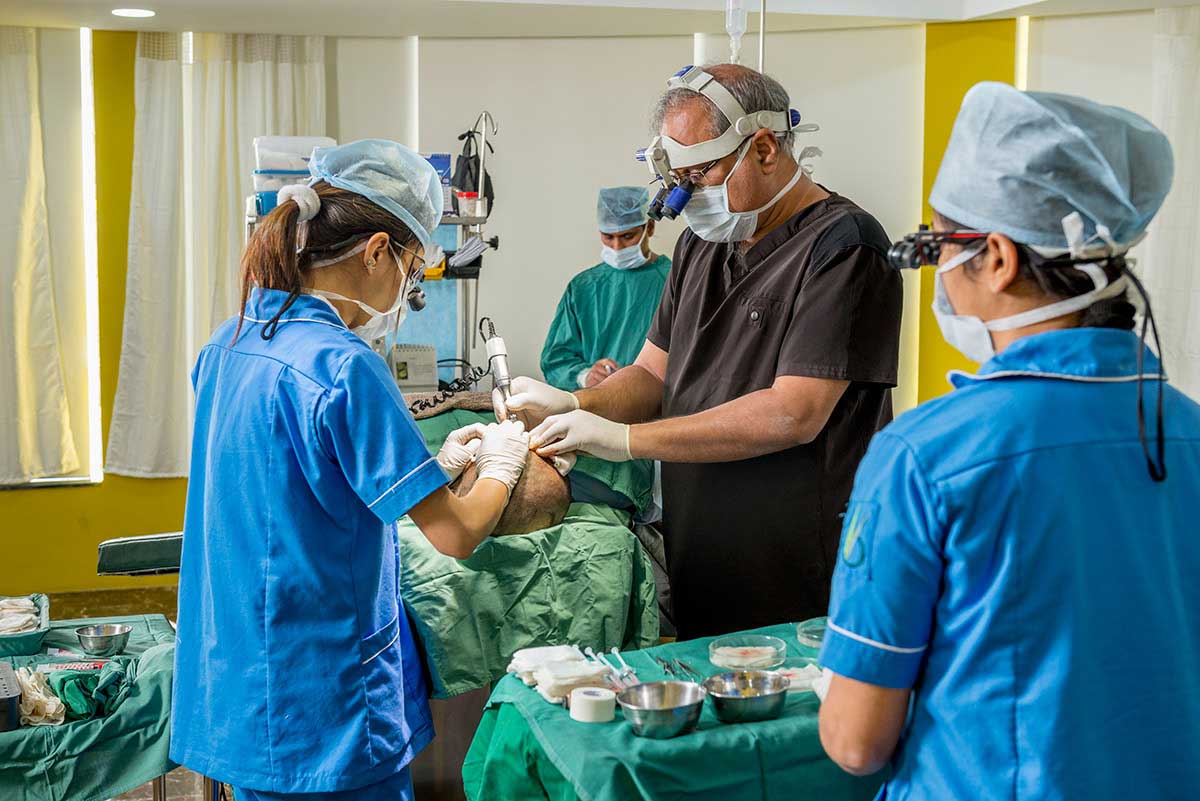

Dr. Tejinder Bhatti engaging in an honest, science-based discussion on the future of hair transplants and hair loss treatment—where clarity, ethics, and patient trust take centre stage.
The landscape of hair transplant in India and global hair loss treatment has shifted so dramatically that the public narrative has often outrun the underlying science. The gap between what hair-loss sufferers hope for and what clinicians can realistically deliver has widened—much like two railway tracks that look parallel from afar but drift apart on close approach. It is the classic reminder that “all that glitters is not gold,” especially in a field where promises travel faster than proof.
For decades, new therapies have been repackaged as revolutions, old claims poured into new bottles, and every fresh crop of patients has re-entered the arena unaware of the lofty promises made to those before them. This market-wide amnesia has fuelled a “promises era,” but not yet a “delivery era.” The hope is palpable, but so is the haze.
As a surgeon who treats pattern baldness daily, I often find myself negotiating this space between aspiration and anatomical truth. When patients hear “cure,” they imagine a full head of hair permanently restored. Yet the real biological landscape is more nuanced: follicles once miniaturised beyond rescue cannot be resurrected, donor reserves are finite, and scalp architecture cannot be magically re-engineered. Even the finest hair transplant cannot reproduce a dense teenage scalp; instead, it reconstructs, restores, and redesigns within the constraints of biology.
Today, the interplay between surgical artistry and regenerative adjuncts has become the central theme in modern hair restoration.
What 2026 Holds: Are We One Mile Away from a Hair Loss Cure?
The global hair-loss market touched USD 52 billion in 2022 and is expected to climb toward USD 88 billion by 2030. With that magnitude comes enormous pressure—innovation on one side, and marketing hype on the other. As the saying goes, “When the stakes rise, so do the tall tales.”
Traditional mainstays like Finasteride and Minoxidil continue to hold their ground. They slow progression, strengthen existing follicles, and occasionally stimulate regrowth—but they are not cures. Meanwhile, the surgical principle remains timeless: relocate robust donor follicles, provide an optimal environment for survival, and maintain the native hair so thinning does not silently undo years of work.
Now, research has entered deeper waters. Scientists are investigating follicular clocks, immune–follicle communication, stem-cell reservoirs, and molecular triggers of the growth cycle. Reviews on emerging therapies for androgenetic alopecia highlight small-molecule inhibitors, biologics, regenerative gels that promote angiogenesis, and topical modulators aimed at awakening dormant follicles. The horizon looks brighter, but the evidence is still maturing.
Ralf Paus—whose work needs no introduction—reminds us that the hair follicle’s intrinsic clock remains a biological riddle. If decoded, it may unlock pharmacological interventions that truly transform hair growth cycles. But for now, this remains a promise, not a prescription.
Some innovations such as SAMiRNA-AR68, and early-phase molecules like PP405, show encouraging signals—PP405 reportedly increasing density by ~20% in a subset of men with viable follicles. Yet the emphasis remains: only follicles that are alive can be stimulated. Scarred or extinguished follicles cannot be revived by molecules.
In autoimmune alopecia, breakthroughs are more tangible: JAK inhibitors, targeted immune modulators, and biologics have radically reshaped management. But their application in androgenetic alopecia—the world’s most common form—remains exploratory.
Bridging Expectation and Reality: The Ethical Imperative
Most patients enter a hair-loss clinic not with science, but with stars in their eyes. The expectation of a “thick hair set” is so deeply emotional that tempering it becomes a delicate art. As the saying goes, “Hope is a good breakfast but a bad supper.” Ethical counselling demands time, patience, and courage—qualities often overshadowed in a market where the loudest sales pitch wins.
I continue to advocate evidence-anchored adjuncts that I trust:
- Finasteride (oral or topical forms as indicated)
- Minoxidil (oral or topical)
- PRP in select indications
- Microneedling
- Strategic surgical planning
These are not flashy but they deliver reproducible benefits, and when combined with a well-executed transplant, they ensure durable results.
When patients ask about “no-scar techniques,” “hair cloning,” or “full regrowth in 6 months,” I remind them: these remain speculative. Stem-cell therapies are moving forward, but scaling them for safe human use is a formidable path.
Hair Transplant Remains the Gold Standard—And an Investment in Happiness
Until emerging therapies prove universal efficacy, a well-planned, doctor-performed hair transplant in India remains a robust and time-tested option. It is not a commodity. It is an investment in years of confidence and self-image. In advanced baldness, where donor availability and follicle viability dictate strategy, surgery remains indispensable.
I map every patient’s future: stabilise now, plan for transplant at the ideal time, preserve donor resources, maintain results, and integrate new therapies as they earn their place. For many, this clarity is reassuring. For others, it is a reminder that in hair loss—as in life—marathons outperform sprints.
The Truth About 2026: A Promise-Heavy Era, A Delivery-Light Reality
As we look toward 2026, the field stands at a pivot. The foundation is solid—diagnostics, meticulous surgical technique, donor preservation, medical stabilisation. The excitement lies in what may soon be layered on top: targeted molecules, biologics, follicle-clock modulators, and immune-rebalancing therapies.
Yet the ethical clinician must navigate this era with discernment. To use science without abusing it. To inform without inflating. To deliver results today while preparing responsibly for tomorrow.
Hair restoration in 2024–2026 is thus a blend of proven science and cautious optimism—anchored in what works, hopeful for what may come. For patients, the real loss lies not in delayed cures, but in lost years of confidence. For those who embark with clarity, partnership, and realistic goals, a hair transplant remains not just a medical procedure but a lifelong investment in happiness.